Advanced FFcP: Over the Fingerboard
We introduce the FFcP patterns as a way of accessing a limited (only 4!) number of ways to finger a major scale. The first lesson FFcP got you started, the second "Moving on Up" shows you how to connect these fingerings into the upper frets, and our third, SuperFFcP launches a daily callisthenic regime to condition your fingers through regular warm-ups.
Note we are assuming that by now, you have spent time playing the original FFcP patterns not only in the original lower (1st) position, but in the upper frets. Varying daily the starting note on these AND the SuperFFcP drills is a good way to get comfortable with those closer upper frets and maintain strength as you work the lower ones. The purpose of this lesson is to get you from one to the next smoothly.
Let's connect melodic "nuggets" in two-octave patterns and stretch you out of the lower fret comfort zone, on into the upper. Mixing up the patterns will help you move in and out of "regions" of the fingerboard and into a whole new familiarity with potentially foreign frets and that smooth bridge to them.

Notice the scale patterns in the attached exercise are NOT consecutively step by step (1, 2, 3, 4, 5, 6, 7, 1). This contrary motion is much more musical and integrating broken thirds can also help your improvisation later sound less like you're only regurgitating out scales. Feel free to explore your own variations, broken 4ths, and even other modes.
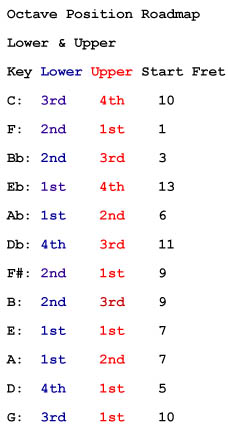
As always, we preach tone first, so play them as slowly as you must to keep articulations clean and note-to-note space minimal. Repeat measures as often as you need before proceeding to the next key. Memorizing these eventually is essential, and you can use the roadmap on the third page as a cheat sheet to get you there much faster.
Download exercise: Patterns Overboard
Below is an excerpt from the last page to assist you in memorizing the exercise, once you get the basic concept down:
Join the FFcP 'Fretboard Yoga' Facebook Group

Disclaimer: In the 'Information Age' of the 21st Century,
any fool with a computer, a modem, and an idea can
become a self-professed 'expert." This site does not
come equipped with 'discernment.'
|